Monday, August 15, 2011

Is The Risk Accompanying Estonia's Eurozone Membership Really So Low?

"But the go-ahead Estonians are already scenting the next challenge. Should the single currency crumble, they are determined to be on the inside track for any new German-centred “super-euro”. Goodbye “eastern Europe”; welcome to the “new north”."
Edward Lucas, writing in The Economist

Estonia's economy put in another sterling performance in the second quarter of this year, even if the expansion rate fell back to quarterly 1.8%, down from 2.4% in Q1, and 2.5% in the last quarter of 2010. Well, you didn't expect the economy to keep growing at such strong rates for ever, did you? Evidently not. The interannual rate peaked at 8.5% in the first quarter, and dropped back slightly during the last three months to 8.4%, still this is no mean pace.


But given that the good things in life don't last forever, the real question now facing analysts and policymakers is not whether a fall of a tenth of a percentage point is significant, but rather the much more critical one of just how long the Estonian economic expansion can be kept going in the face a a more general European slowdown, given that the economy is now almost entirely dependent on export expansion for GDP growth?

Exports have been very strong so far this year. Although imports have more or less risen in lock-step.


Consequence, while the goods trade deficit has been substantially reduced, what remains stubbornly resists being eliminated.


Which draws attention to another feature of Estonian goods exports, a lot of them are processed products which are effectively re-exports of previously imported components, hence the value added component supplied by Estonian manufacturing is comparatively small. The share of value added in manufacturing (as a % of GDP) has risen sharply in recent quarters, from the earlier crisis lows, but at around 19.5% it is still up only about 1.5% on the pre-crisis levels. However, within this the share which is oriented to exports has undoubtedly risen.


Still, with value added in manufacturing under 20% of GDP, driving growth forward in the future is not going to be easy, especially now that a Europe-wide slowdown is gradually taking hold. And in a sign of what may now be to comme, exports fell sharply in June, to around 950 million Euros, from an average of 1.1 billion euros in the March to May period.

Indeed industrial output hit a local high in March, and has subsequently fallen back.


Retail sales are barely up from their sharp drop, and are unlikely to give much momentum to the economy in the months and years to come due to the substantial debt overhang which the household sector is still struggling with.


Likwise there is not much sign of a return to life in the construction sector outside government sponsored infrastructural activity.


Unemployment has fallen, but continues to remain high, and in fact the 7,000 drop between Q1 and Q2 is really quite small when seasonal factors and the fact exports were growing furiously are taken into account. It would thus not be surprising to see the numbers of unemployed once more rising going into the winter.


So the big question here is not whether Estonians worked hard to contain their fiscal deficit (which they obviously did), or whether they carried out some form of internal devaluation (they surely did). The key question is whether their internal devaluation went far enough, and whether the exchange rate with which the Estonians entered the Euro was not too high for their needs (a mistake the Germans made in the late 1990s, and which they subsequently paid for in quite costly fashion).

What does not seem to be generally understood in this whole "Estonia" debate is what the expression "export dependence" means. It doesn't simply mean that exports will play a significant part in forthcoming Estonian growth (I think that all parties are now agreed that this will be the case). It means that the level of household indebtedness coupled with the ageing population phenomenon means that domestic consumption driven growth is now a thing of the past, and what is worrying about the Estonian situation is the comparatively small size of Estonia's manufacturing industry.

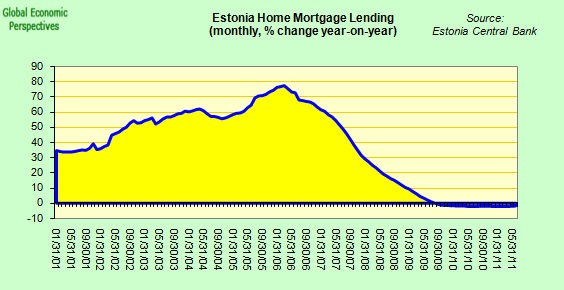
New credit growth has all but disappeared in Estonia.


Something which is in many ways reminiscent of what happened in Germany following the unwinding of their 1990s consumption boom.


People are still waiting for the return of a housing boom in Germany (see mortgage chart below) but they will wait idly, demography virtually guarantees that, just as they will wait idly in Estonia for a return of the good old days, and meanwhile precious time is being lost.


Estonia's current account has now corrected:


Just as the German one did before it.


But Estonia still has some way to go before it realises CA surpluses on the scale which Germany does. And it still has even more way to go before it recovers the level of economic output attained before the onset of the crisis. Despite the strong recovery of the last year, Estonian GDP is still 10% down on its earlier peak.


Which is why it is worrying that Estonian inflation continues to run above the Euro Area average. This is not the way to improve competitiveness, and it is horribly reminiscent of the path which was trodden by peripheral economies to the West and the South after they joined the common currency. It doesn't really seem that too many lessons have been learnt here.


Strangely, as a country which has recently entered the common currency, country risk seems to have followed a path which is rather nearer to that of its Baltic peers than to that of equivalent Euro Area countries. Credit Default swaps on Estonia have fallen and remain down, whilst those of its East European Euro peers (Slovenia and Slovakia) have risen as one might expect as the crisis of confidence in the currency has grown.


It is not my intention here to single out Estonia for special - negative - treatment (that would not be warranted) but the value being placed on the CDS really is incredibly low for a country that just entered a Euro Area whose outlook could, at the very least, be considered as reasonably uncertain. It is being priced as part of core Europe, when in reality it forms part of Europe's periphery. Evidently, were the Euro to break in two, Estonia would incline towards riding with the German lead group, but given the fact that the country now has a totally export dependent economy, and a currency which was arguably over valued at the time of Euro entry (and continue to have ongoing above-Eurozone-average inflation) it is not clear how prepared the country would be to handle the challenges of being attached to the new, and ultra-high value, currency which would be created.


Thus we find that a country which two years ago was being valued as having the third-riskiest sovereign debt in the European Union is now trading in quite another league, and finds itself included among the European "top ten" sovereigns in terms of price. Last week, while French CDS were hitting Euro era highs of around 160 bps, Estonian ones were sitting pretty at around 115. And just after S&Ps downgraded US sovereing debt, they upped the Estonian rating by two notches to AA-.


Their Valour Is Not In Doubt

"That he which hath no stomach to this fight,
Let him depart; his passport shall be made,
And crowns for convoy put into his purse;
We would not die in that man's company
That fears his fellowship to die with us".
William Shakespeare, Henry V, the Saint Chrispin's Day Speech

So the question I ask myself (as I did in this earlier post), is whether this kind of realignment in valuations makes any kind of economic sense? Of course positive comparisons with the United States and France are flattering, but am I the only one to see something funny going on here? Is contagion risk being reasonably priced in, is the risk of Euro Area break up being adequately priced, and if it isn't, do we not face the risk of a sudden (and hence destabilising) adjustment in the not too distant future?

Is there now nothing left to economic life but fiscal policy, or have we all collectively lost our sense of perspective? How can an economy which still shows the living scars of its earlier sharp distortions be so highly rated?

Obviously, it is clear that the Estonian Sovereign was never, even during the worst moments of the financial crisis, and under the most severe of worst case scenarios, the third riskiest to be found within the frontiers of the EU (Estonia was the only EU country to have a budget surplus last year - worth 0.1 percent of GDP - while public debt totaled a mere 6.6 percent). On the other hand it is the case that Estonia faced an extremely challenging crisis in 2008/09, and had the Euro peg collapsed in one of the four East European countries who had one at the time then the pressure of private debt could certainly have confronted the country with some very complex and difficult choices.


But Their Wisdom, And Sense Of Foresight.........

Following the argument along a bit, it is far from clear that the current level of Estonian CDS prices risk in in any more satisfactory way than it did at the height of the crisis, since membership of the Eurozone has brought with it both positives and negatives. The 0.28% contribution of the country to any future EFSF bailouts may not seem like a very big deal, but in comparison to Estonian GDP the sums involved may well be far from trivial. The country does not have, and is not likely to have, either a fiscal deficit or a sovereign debt problem, nor does it have a home grown banking system which might need bailing out. The risk to Estonia comes from elsewhere, from its association with Ireland, Spain, Greece, Portugal and Italy. Depending on how far the core EU countries are willing to finance debt and absence of growth in those countries the Eurozone's future is far from clear. If, as Edward Lucas speculates, a division to go with the strong currency German lead component which could be created in the case of break-up, Estonia's leaders may live to rue the day they missed the opportunity to make a substantial devaluation in the currency before entering the Eurozone.

This post first appeared on my Roubini Global Economonitor Blog "Don't Shoot The Messenger".

Thursday, August 04, 2011

Could There Really Be A Recession Risk In Germany?

Oh, come on Edward, surely this time you are going too far? The Germany economy is the strongest in Europe, time and again we have been told it is powering and powering ahead. It has just demonstrated record growth performances. So where the hell could you possibly get the crazy idea that Germany might be in for a double-dip recession? Must be the summer Spanish heat.

Well, no. Perhaps the idea is not as absurd as it seems at first sight. Try taking a look at this chart (exhibit A), for starters. This is what just happened to German manufacturing industry.


It is the monthly manufacturing PMI chart, and note the sharp smooth downward line, which stretches from February's high point of 62.7, down to July's 52. Yes, German manufacturing industry is still expanding, but only just, and it is the pace of the slowdown which is remarkable.

And this months report made plain there is worse to come, since as Tim Moore, senior economist at Markit informed us: “New order levels went into reverse in July, as fewer export sales helped end a two-year period of sustained growth". The report also highlighted a reduction in export sales, with the pace of contraction being the fastest since June 2009.

We can also find a reflection of what we are seeing in Germany out in East European economies like the Czech Republic, where the rate of economic expansion has also slowed sharply. This is not surprising, since these economies are all tightly roped together via the German export machine.


Well, OK, German manufacturing industry is slowing, but that's only one part of German activity, surely the rest of the economy will have sufficient momentum to keep moving forward? We this is where I bring in what I consider to be my "killer app", which is the fact that Germany has an export dependent economy.


In Germany movements in GDP follow movements in the rate of expansion of exports. Let's not get into why that is for the moment (think Germany's particular demography), and just consider the possibility, despite all the talk over the years of Germany finally "decoupling", that it can't. Export dependence could well be the key explantaion for why the performance of the German economy is so "extreme" and so volatile, with quarters of record growth being witnessed just before the onset of substantial recessions, recessions which often register record falls in output only to be followed by massive recoveries. The reality is not that Germany is either a growth or a contraction champion, but that export dependency simply makes the German economy more volatile and more susceptible to sudden changes than those of some of its neighbours (like France).


In fact Germany's long term trend growth has been falling steadily.


We Can See The Slowdown Everywhere, Except In The ECB Rate Policy

But why do you insist that this won't simply be a slow patch, or a soft spot? Even the bundesbank is saying that German growth in the second half of the year won't be as strong as in the first half. Well, here comes exhibit B. The slowdown is global, and for an economy which needs growing exports to grow, then a global slowdown is a real problem.


Even China (that other great export driven economy) is feeling the heat, with new export orders also having slid into contraction territory.


And there are more indications than simply the PMI that the economic outlook in Germany is deteriorating. We have the IFO sentiment index, which has now entered overall decline.


And then there is the latest European Confidence Index reading:


Naturally, none of these readings are definitive, but they are what we have at this point, since data from June is hardly helpful to tell us what will happen in August, which is why we need to rely on the "softer" forward looking indicators.

And obviously I can only discern something about the situation such as it is now. Should Ben Bernanke (as I argued in this post here) decide to go ahead with another bout of quantitative easing, Germany would probably be one of the leading beneficiaries, but that is the world we might have, and not the one we actually have as of this moment. So summing up I cannot do better than Tim Moore, senior economist at Markit and author of the PMI report, who said in his final comment:

“July’s final PMI data confirmed a sharp slowdown in German private sector growth, with output levels rising at the weakest pace since the autumn of 2009. The month-on-month loss of growth momentum was also the steepest since the recovery began two years ago. New business gains meanwhile hit a stumbling block in July as heightened economic and financial market uncertainty encouraged clients to delay spending decisions. The latest overall rise in new order levels was the slowest since the start of the upturn, which in turn is likely to weigh on business confidence and job hiring in the months ahead.”


This post first appeared on my Roubini Global Econmonitor Blog "Don't Shoot The Messenger".

Wednesday, August 03, 2011

Spain's High Risk Election Process

As Mr Zapatero put it on Saturday, when he announced the date of Spain's general election, the decision "is in the country's interest" since from now on there will be certainty, and "certainty is stability". While it is quite possible that almost all of Spain's politicians shared this sentiment, and welcomed the bringing forward of the election date, they may very well be the only ones to do so. Certainty is undoubtedly a strong positive, but when the only thing about your country which people can be certain of is the election date, then maybe on balance you won't have gained much.

In fact, as we are now seeing, you may well have lost a lot, and thus many of those who assented to the announcement with a knowing nod of the head may already be rueing the careless moment when they did so, as the country's debt crisis escalates, and the sovereign spread with Germany hits ever higher levels. Could they not comprehend that, seen from the outside, the very fact that the coming of these elections could be seen as good news inside Spain simply constituted one further illustration of just how parochial the country's politicians are, and how detached from economic realitities of their country they have become? They have simply turned themselves into the victims of their own propaganda, since if they hadn't been watching too much Spanish television they would have realised the the country's economy was on the verge of a double dip contraction, and not the imminent recovery which was used as justification for the election call.


Had they read their own official and Eurostat reports they would have known that unemployment was rising not falling - it hit 21% in June according to Eurostat data, and went up by a seasonally adjusted 29,603 between June and July, according to the monthly report from the Spanish labour office.


And had they been following events on the ground rather than election timetables they would have been aware that the housing market,far from having bottomed out had just entered another downward slump. The interannual rate of price decline according to the TINSA valuers index has risen steadily from 3.71% in March, to 4.38% in April, to 5.88% in May, to 6.6% in June. Back in October last year Mr Zapatero famously informed a stupified Maria Bartiromo from CNBC that Spanish house prices had bottomed:

MS. BARTIROMO: Are you expecting real-estate prices to continue coming down? Have they hit the bottom or not yet?

PRIME MIN. ZAPATERO: I think that the price of housing has hit the bottom. It won’t go down any more. For the past two or three months, what we see is that not only has it not dropped. But in certain parts of Spain, the price of housing has gone up. This is especially the case in those areas of — not where people are buying their second house, if you like, with the prices there have still gone down a bit, but rather where they’re buying their first, there the prices have gone down in the housing sector. So in general the prices have been stable recently, and they’ve even been increasing. So demand seems to be ticking up again.


Even more importantly, the recent rise in the 10 year bond yield (and spread) had been giving clear signals that the whole "decoupling" thesis behind whose figleaf the Spanish administration had been guarding their chastity had now become bereft of all credibility.


So the only (and I do mean only) positive Spain had to cling onto before the markets was the credibility it could have earned by coming in with a 6% deficit result on target this December.

If Spain needed a change of government (and I fully accept it did), then what it needed was some kind of "save the nation" (and the euro) coalition, to thrash out what would effectively be a new set of Pactos de la Moncloa, such is the gravity of the situation facing the country, and indirectly the European Union. (The Pactos de la Moncloa were the agreements reached between the various parties to facilitate a bloodless transition from dictatorship to democracy in the initial post-Franco years). But times have changed, and far from being able to achieve major aggreements of state, Spain's political parties are typically too heavily committed to endulging themselves in squabbling over the post boom-years leftovers to busy themselves with more pressing concerns like finding collective solutions to their country's (and Europe's) problems.

Outside Spain things are seen in a rather different eye. Victor Mallet, writing in the Financial Times, put it like this: "neither the certainty of an election date nor the probable victory of the rightwing opposition Popular party will necessarily soothe investors’ fears about where Spain is headed", he said, just before citing Nicholas Spiro of Spiro Sovereign Strategy to the effect that “Spain’s debt market needs this election like it needs a hole in the head". Well, some of the country's leaders might be forgiven for feeling, in the light of what has now transpired, that it is they and not the markets who have been left with a hole in the head, or at least a large gaping hole in the side of their already leaky ship.

Mr Zapatero's actual choice of words was at one and the same time interesting, and revealing. “On January 1, the new government must work on economic recovery and on reducing the deficit.” Excellent, the thread will be picked up again at the start of 2012. And in the meantime? The real issue facing investors and financial market participants at this moment is what is going to happen to the deficit between now and the 31st December. By no stretch of the imagination can Spanish pre-election periods be considered to be propitious for spending cuts.

Concerns about regional spending were already widespread before the election announcement. Commerzbanks Ralph Solveen in a report expressing widely shared views and revealing the sense of frustration already felt by many analysts and observers, desribed the possibilty of Spain achieving the 6% target by the end of this year as increasingly remote. And his reasoning was impeccable:

The Spanish central government is still only managing to reduce its budget deficit at a very slow pace. According to figures published today, its deficit for the first half of the year was just €5.6 billion lower than in the same period last year. In addition, most of the Spanish regions reported higher deficits than last year, so this year's target for reducing the overall government deficit ratio from 9.2 per cent to 6 per cent, is now receding into the distance.......This figure is only slightly higher than the reduction of €4.5 billion that was reported at the end of May, such that the reduction per month fell.

Consequently, the target set for reducing the overall government deficit by more than three percentage points this year is becoming even more remote, all the more so because the first quarter deficits reported for the regions were, on average, even higher than last year. The figures for the second quarter are not yet available, but reports for individual regions such as Castile-La Mancha bring little hope of a significant change for the better.


Part of the reason for the slow rate of deficit reduction has been the fact that economic growth is slower than forecast, a problem which is hitting revenues. Naturally a further batch of measures really are needed, but what sort of "swingeing cuts" can we realistically expect to see from a government which is in the midst of a battle for its political life? Telling government employees that they will lose half of their 2 extra monthly payments (one policy option strongly rumoured to have been under consideration before the election announcement) would hardly be likely to win them votes.

As I say, the tragedy in all this is that achieving the deficit target was about the one (and only) thing the government had going for it. The only real proof of its seriousness. Despite all the scepticism about (and slippage in) regional finance, I would have been prepared to sign on to the idea that Spain's deficit would still come in around the 6% mark. But now,.......

The deficit progress was what Spain had to put on the table, since when you come to all the rest, economic growth, employment and unemployment, financial sector reform, the housing market the only thing the sky was really full of were black clouds.


Naturally, the election declaration was only what the Greek historian Thucydides would have called the efficient cause (or trigger) for the next stage in the crisis, the final cause is the inability of either Madrid, or Brussels, or Washington (the IMF) to come up with an adequate policy mix to drag the Spanish economy out of the hole into which it has fallen, and into which (short of viable remedies) it will soon drag the Spanish and then the European financial systems along behind it.

Going naked (not a fig leaf is left) into the conference chamber sounds like a very apt and appropriate desciption of where Mr Zapatero and his team are right now. The situation can hardly be comfortable for them, but then, at the end of the day sympathy would be misplaced, since the only people responsible (or should that be "irresponsible") for the decision and hence the situation are they themselves and those who lead the governing PSOE party. Unfortunately though they will not be the only ones who pay the consequences.

This post first appeared on my Roubini Global Econmonitor Blog "Don't Shoot The Messenger".